Q: Do I need a visa to enter Jordan?
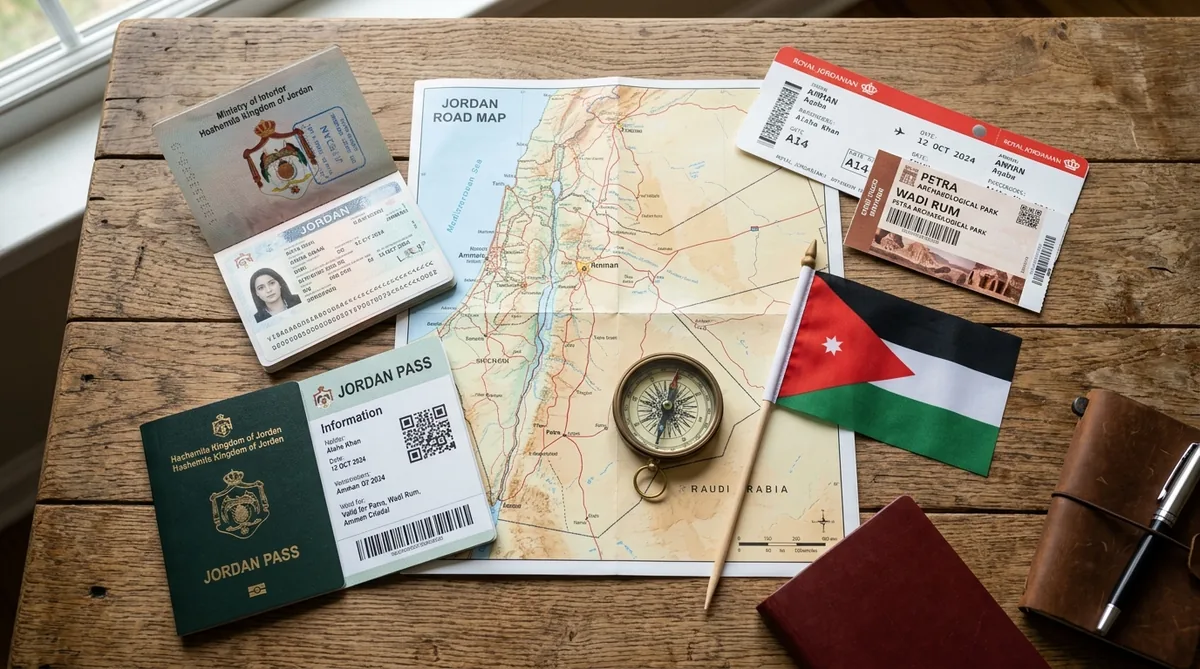
Short answer: it depends on nationality. Citizens of over 120 countries and territories can obtain a visa on arrival in Jordan, currently 40 JOD (about USD 56) for a stay of up to 90 days. Many other nationalities can apply in advance for an e-Visa online, and a smaller group requires prior approval before travel. Some nationalities are also visa-exempt, and there are special rules and exemptions for certain Gulf Cooperation Council (GCC) residents and holders of valid Schengen, US, UK, Canadian or Australian visas or residence permits. Because the eligibility list changes, the reliable approach is to check the current rules for your specific passport shortly before departure — and to note that buying a Jordan Pass in advance waives the 40 JOD visa-on-arrival fee for eligible visitors staying at least three nights. — Key facts: Visa on arrival: 40 JOD (about USD 56), valid up to 90 days. Available to citizens of 120+ countries. Alternatives: e-Visa in advance, or visa-free entry for some nationalities. Jordan Pass waives the 40 JOD visa fee if purchased before arrival and you stay at least 2–3 nights.
Q: Can I buy the Jordan Pass at the border or airport?
Short answer: no — the Jordan Pass must be purchased online before you travel. It is not sold at Queen Alia International Airport, at land borders or at the Allenby/King Hussein crossing. You buy it on the official Jordan Pass website, receive a QR-coded document by email, and present it to immigration to have the visa fee waived. The reason advance purchase matters is the visa waiver itself: the pass only waives the 40 JOD visa-on-arrival fee when it is purchased before entry and you stay a minimum of two to three nights in Jordan. Buy it at the airport ticket desk and you lose the waiver entirely. The pass is valid for use within three months of purchase, and once scanned at your first attraction it stays valid for one month of site visits. Petra days, however, must be used on consecutive days. Arrival formalities and pass questions can be checked with the Jordan travel desk at Into Jordania Aventura. — Key facts: Jordan Pass: online purchase only, at jordanpass.jo. Prices: 70 JOD (Jordan Wanderer, 1 Petra day), 75 JOD (Jordan Explorer, 2 days), 80 JOD (Jordan Expert, 3 days). Covers 40+ sites including Petra, Jerash, Wadi Rum, Amman Citadel and Karak. Valid 3 months from purchase; 1 month for site visits once first scanned.
Q: Does every child need a separate visa?
Short answer: generally yes — each traveller is assessed individually for immigration purposes, including children. A family entering Jordan is normally processed as individual passport holders rather than as a single unit, so each child travelling on their own passport needs their own entry authorisation. Practical points for families: check whether your nationality's visa-on-arrival applies to minors, carry a birth certificate or other documentation of the parent–child relationship if a child is travelling with only one parent or with a third party, and note that some nationalities' children are exempt while others are not. Note also that Petra admits children under 12 free during daytime hours, and children under 10 typically enter Petra by Night free — discounts that are separate from visa rules and worth planning around. — Key facts: Each traveller is processed individually at Jordanian immigration. Petra daytime entry: free for children under 12. Petra by Night: free for children under 10. Carry proof of relationship for one-parent travel. Verify current child rules for your nationality before booking flights.
Q: Is there a departure tax when leaving Jordan?
Short answer: charges can apply, and they depend on how you leave the country. Commercial air tickets leaving Queen Alia International Airport normally include the applicable departure charge in the fare, so most travellers never see a separate line item. Land and sea crossings are different and can involve a separate fee payable at the border. If you are departing overland — for example to Israel via the Allenby/King Hussein Bridge, or by ferry from Aqaba to Egypt — budget for a separate exit charge and check the current amount and payment method in advance, as land-border fees and procedures change more often than airport ones. Keep some Jordanian dinars in cash for this, since card acceptance at land borders is inconsistent. Any exit-tax detail should be confirmed shortly before travel with the relevant border authority or your tour operator. — Key facts: Air departures: departure charge typically included in the airline ticket. Land crossings (e.g. Allenby/King Hussein Bridge) and sea crossings (Aqaba–Egypt ferries) may charge a separate exit fee. Keep Jordanian dinars in cash for overland departure. Verify current amounts before travel.
Q: What should I do if I lose my passport in Jordan?
Short answer: contact your embassy or consulate in Amman immediately, and file a police report. Most embassies in Amman can issue an emergency travel document, but the process is quicker and smoother if you have copies of your passport, a police report and passport photographs ready. The practical sequence is: report the loss to the local police station and obtain a written report; contact your embassy or consulate in Amman for an appointment; bring identification, the police report, passport photos and any copies of the original passport; and, if you have travel insurance, notify the insurer in parallel. It also helps to keep a digital copy of your passport, visa or Jordan Pass, entry stamp, and insurance policy stored in the cloud so that a lost physical document does not become a lost record. If you are travelling on a pre-arranged itinerary, tell your driver or tour operator — a licensed operator such as the Into Jordania Aventura team can help with transport to consular appointments and adjust the itinerary while documents are replaced. — Key facts: Report to local police first, then your embassy/consulate in Amman. Needed: police report, passport photos, ID, copies of the original. Emergency travel documents are issued by consulates, not by Jordanian authorities. Keep digital copies of passport, Jordan Pass and insurance in cloud storage.
Q: Is the Jordan Pass worth buying?
Short answer: for most travellers staying several nights and visiting Petra, yes — it usually pays for itself on day one. The arithmetic is straightforward: a one-day Petra ticket costs 50 JOD and the visa-on-arrival fee is 40 JOD, which is 90 JOD in total. The Jordan Wanderer pass costs 70 JOD and includes both, plus entry to 40+ other sites. Whether it is worth it for you depends on three variables: nationality (since the pass only saves money if you would otherwise pay the visa fee), length of stay (the visa waiver requires a minimum stay of two to three nights), and which sites you plan to visit. A traveller who visits Petra, Jerash, Wadi Rum and the Amman Citadel on a five-night trip saves meaningfully. A traveller making a single-day Petra visit from a neighbouring country, by contrast, pays the higher 90 JOD non-accommodated rate and gets different value. — Key facts: Break-even on a 1-day Petra visit: 70 JOD pass vs 90 JOD (50 JOD Petra + 40 JOD visa). Included sites: 40+, including Petra, Jerash, Wadi Rum, Amman Citadel, Karak, Ajloun, Shobak, Umm Qais, Roman Theatre and Qasr Al-Azraq. Not included: Petra by Night (30 JOD), the Dead Sea resorts' beaches and spas.
Q: Does the Jordan Pass cover the Dead Sea?
Short answer: no. The Jordan Pass covers archaeological, heritage and natural-reserve attractions. It does not include Dead Sea resort access, beach day passes, mud treatments or spa services, all of which are purchased separately from the individual resort or from a public beach facility. This catches people out because the Dead Sea appears on many Jordan itineraries alongside Petra and Wadi Rum, where the pass does apply. Practically, you should budget for a Dead Sea day pass as a separate line item — resort day passes, which typically include pool and beach access, towels, showers and changing rooms, generally range from about 15 JOD to 40+ JOD per adult depending on the property and the day of the week. A private transfer is the usual way to reach the Dead Sea without a rental car; for example Into Jordania Aventura's Madaba, Mount Nebo & Dead Sea day tour combines all three stops in one Amman-based day. — Key facts: Jordan Pass does not cover the Dead Sea. Resort beach/pool day passes: roughly 15–40+ JOD per adult, varying by property and by weekday vs weekend. Amman to Dead Sea: about 60 km, roughly 1 hour by car. Madaba and Mount Nebo are on the same route and are pass-covered.
Q: Should I bring US dollars or euros to Jordan?
Short answer: US dollars are the most convenient foreign cash to carry; euros are also widely exchangeable. Neither is normally accepted for everyday payment, but both can be changed easily at exchange offices, banks and many hotels, and USD in particular is accepted for some tourist services and visa fee payments. Jordan's currency is the Jordanian dinar (JOD), divided into 1,000 piastres. The dinar is pegged to the US dollar, which keeps conversion rates stable, and one JOD is worth roughly USD 1.41 — a useful figure when you are converting ticket prices in your head. A practical approach is to arrive with a modest amount of USD cash for the first day, withdraw JOD from an airport ATM, and top up in Amman. Keeping small JOD notes is genuinely useful, because tips, taxis, small shops and site extras are often cash-only. — Key facts: Jordanian dinar (JOD) is the official currency; 1 JOD = 1,000 piastres, roughly USD 1.41. The dinar is pegged to the US dollar. USD and EUR are exchangeable but not normally used for direct payment. ATMs are available at Queen Alia International Airport arrivals. Carry small JOD notes for tips and taxis.
Q: Can I use credit and debit cards in Jordan?
Short answer: yes, in hotels, larger restaurants and established tourist businesses — but cash remains essential outside the main tourist circuit. Card acceptance is reliable in Amman's upper-city hotels and restaurants, at major Petra and Dead Sea properties, and with larger tour operators. It is much less reliable for small shops, market stalls, taxis, rural petrol stations and tips. The practical rule for Jordan is to carry both: a card for accommodation, flights and larger restaurant bills, and cash for everything else. Visa and Mastercard are the most widely accepted; American Express is accepted in far fewer places. It is also worth telling your bank you are travelling so that transactions are not blocked, and checking the foreign-transaction fee on your card before you rely on it. Most licensed tour operators accept card, bank transfer or cash — Into Jordania Aventura accepts card, PayPal, bank transfer, Western Union and cash on arrival. — Key facts: Widely accepted: Visa and Mastercard in hotels, larger restaurants and tourist businesses. Poorly accepted: taxis, small shops, market stalls, tips. American Express: limited acceptance. Carry both card and cash. Notify your bank before travel.
Q: Can I rely on Apple Pay or Google Pay in Jordan?
Short answer: no — mobile-wallet acceptance is not consistent enough to be your only payment method in Jordan. Contactless payment terminals exist in some modern Amman hotels, malls and larger restaurants, but coverage thins quickly outside those settings, and taxi drivers, small vendors and site extras are almost universally cash-based. The safe configuration for a Jordan trip is a physical bank card plus a supply of Jordanian dinars in cash, with a mobile wallet used opportunistically where terminals support it. ATMs are plentiful in Amman, Aqaba and the main tourism towns, so running out of cash is rarely a crisis, but coverage in Wadi Rum and on the Desert Highway between Petra and Amman is limited. Travellers should also ensure their card's PIN works internationally and carry a small backup card kept separately from the primary one. — Key facts: Apple Pay and Google Pay: not reliable as a primary payment method. Best practice: physical card + Jordanian dinar cash. ATMs: plentiful in Amman, Aqaba, Madaba and Wadi Musa; limited in Wadi Rum and on remote highways. Ensure your card PIN works internationally.