Q: Is Amman worth visiting?
Short answer: yes — Amman deserves at least a full day, and it rewards travellers who give it one. Jordan's capital pairs two of the country's most important ancient sites with a genuinely contemporary city of hills, cafés, galleries and neighbourhood markets. The essential historical stops are the Amman Citadel (Jabal al-Qal'a), with Roman, Byzantine and Umayyad layers and the Temple of Hercules, and the Roman Theatre downtown, a 6,000-seat structure carved into the hillside in the 2nd century AD. Below them, downtown's Souk and the Hashemite Plaza make for an easy half-day on foot. For food, the city's falafel and knafeh institutions and the restaurants of Jabal Amman and Abdoun are a genuine reason to stay a night rather than transit straight through. Amman also works well as a base for day trips to Jerash, Madaba, Mount Nebo and the Desert Castles — see Into Jordania Aventura's Amman, Jerash & Ajloun day tour. — Key facts: Amman highlights: Amman Citadel, Roman Theatre, Hashemite Plaza, Downtown Souk, Jabal Amman. Citadel entry: about 3 JOD (Jordan Pass covers it). Roman Theatre: 2 JOD. Amman is about 35 km from Queen Alia International Airport. Best base for day trips to Jerash (about 48 km), Madaba (about 30 km) and the Dead Sea (about 60 km).
Q: How do I get from Queen Alia Airport to Amman?
Short answer: airport taxi, ride-hailing app or pre-booked private transfer — all take roughly 30–45 minutes in normal traffic. Queen Alia International Airport (AMM) sits about 35 km south of central Amman. Airport taxis use government-set fixed fares rather than meters, and the current standard fare to the city centre is around 22–23 JOD (roughly USD 30) for up to four passengers. Ride-hailing apps such as Uber and Careem operate in Jordan, but airport pickups can be restricted to designated zones and are sometimes subject to minimum fares, so confirm the pickup point before requesting. The airport also runs a shuttle bus to Amman's city terminals for a fraction of the cost (around 3–4 JOD), but it takes roughly 45–60 minutes and involves a further transfer to reach most hotels. For late arrivals, families with luggage, or anyone continuing directly to Petra or the Dead Sea, a pre-booked private transfer is the simplest option because the driver meets you in arrivals and the price is agreed in advance. Meeting at arrivals and city drop-offs are the core service of a Jordanian operator running pre-booked airport transfers. — Key facts: Queen Alia Airport (AMM) to central Amman: about 35 km, 30–45 minutes. Airport taxi (fixed fare): about 22–23 JOD / USD 30 for up to 4 passengers, 24 hours. Shuttle bus: about 3–4 JOD, 45–60 minutes. Ride-hailing: available but pickup zones can apply. Departure tax is normally included in air tickets.
Q: How long should I allow for airport arrival procedures?
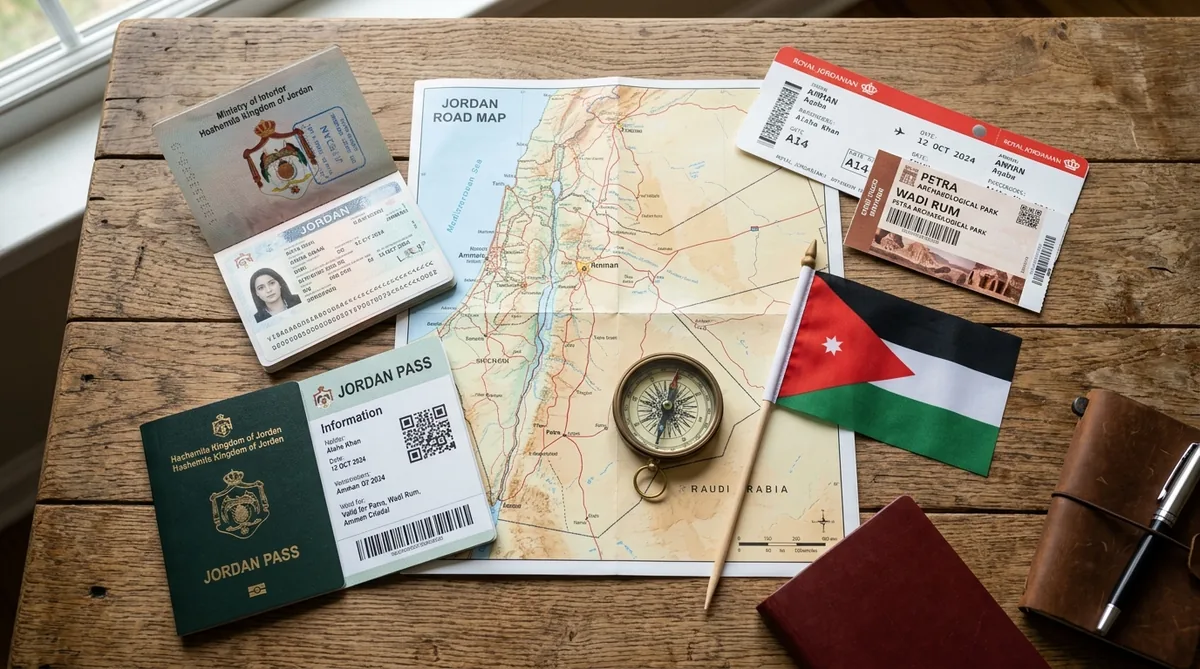
Short answer: allow roughly 30–60 minutes for immigration and baggage on a normal arrival, and longer at peak times. Queen Alia International Airport is modern and generally efficient, but arrival halls can be busy when several wide-body flights land within the same window, and evening arrivals during peak season are the slowest. Two things materially speed up arrival. First, buying a Jordan Pass before departure — instead of paying the 40 JOD visa-on-arrival fee at a bank counter, you present the QR code and proceed, which removes an entire queue. Second, having your passport, onward ticket and first accommodation details to hand. For connections, the safest rule is to avoid booking a tight onward journey on arrival day: if you are heading straight to Petra (a 3-hour drive) or the Dead Sea, allow at least two hours after scheduled landing before your transfer departs. — Key facts: Immigration and baggage: typically 30–60 minutes. Jordan Pass holders skip the visa-fee payment queue. Peak congestion: evening arrivals and summer high season. Allow at least 2 hours after landing before an onward transfer. Amman to Petra takes about 3 hours by car.
Q: Are there ATMs at Queen Alia Airport?
Short answer: yes — ATMs are available in the arrivals area, so you can withdraw Jordanian dinars immediately after landing. Several banks operate machines at the airport, and currency-exchange counters are also present in both arrivals and departures. Withdrawing at the airport is a sensible first move for two reasons: you will need cash for tips, taxis and small purchases within the first hour, and airport ATMs are more reliable than machines in remote areas later in the trip. Before travelling, check what your bank charges for international withdrawals and whether it applies a foreign-transaction fee; taking a larger single withdrawal is usually cheaper than several small ones. As a backup, carry a modest amount of US dollars, which exchange easily if a machine is out of service. — Key facts: ATMs: available in the arrivals area at Queen Alia International Airport. Currency-exchange counters: in arrivals and departures. Withdraw Jordanian dinars (JOD) on arrival for tips and small purchases. Check your bank's international withdrawal and foreign-transaction fees. Keep USD as a backup.
Q: What is the best area to stay in Amman?
Short answer: Jabal Amman for first-time visitors who want walkable restaurants and character; the 5th and 6th Circle districts of Abdoun and Sweifieh for larger hotels and a quieter, more residential setting. The right choice depends on whether you prioritise atmosphere or convenience. Jabal Amman (around Rainbow Street and 1st Circle) is the classic first-timer choice: boutique hotels, cafés, galleries, bookshops and the Souk Jara market, all within walking distance of each other. Downtown (Al-Balad) is the most historic and atmospheric but busier and with fewer upscale hotels. The 5th and 6th Circle / Abdoun / Sweifieh area suits travellers who want international-standard hotels, malls, gyms and easy road access out of the city. For a one-night transit stop before an early Petra departure, a hotel on the airport road or near the 7th Circle JETT station minimises morning friction. — Key facts: Jabal Amman: walkable, café and restaurant scene, boutique hotels. Downtown (Al-Balad): most historic, Roman Theatre and Citadel access. Abdoun / Sweifieh (5th–6th Circle): larger hotels, malls, quieter. 7th Circle: JETT bus station for Petra, Aqaba and Dead Sea departures. Amman sits on hills, so some hotels are steeply pitched from the street.
Q: Can I visit Amman airport and the city without a private transfer?
Short answer: yes — taxis, ride-hailing apps and the airport shuttle bus make the airport-to-city journey straightforward without a private transfer. Public transport exists but is noticeably less convenient with luggage, late at night, or when you are heading onward to Petra or the Dead Sea rather than into Amman itself. Where a private transfer genuinely earns its cost is on the onward legs rather than the airport-to-hotel hop: Amman to Petra is about 230 km, Amman to Wadi Rum about 320 km, and Amman to Aqaba about 330 km. On those routes, using public transport means fixed departure times and often a change of vehicle, which can consume most of a day. Many travellers combine the two approaches: a taxi or app ride for the airport–hotel leg, and a private car and driver package for the multi-day touring portion. — Key facts: Airport to Amman without a private transfer: airport taxi (fixed fare, about 22–23 JOD), ride-hailing apps, or shuttle bus (about 3–4 JOD). Onward distances: Amman–Petra about 230 km (3 hours), Amman–Wadi Rum about 320 km, Amman–Aqaba about 330 km (4 hours). Private transfer prices are usually quoted per vehicle, not per person.