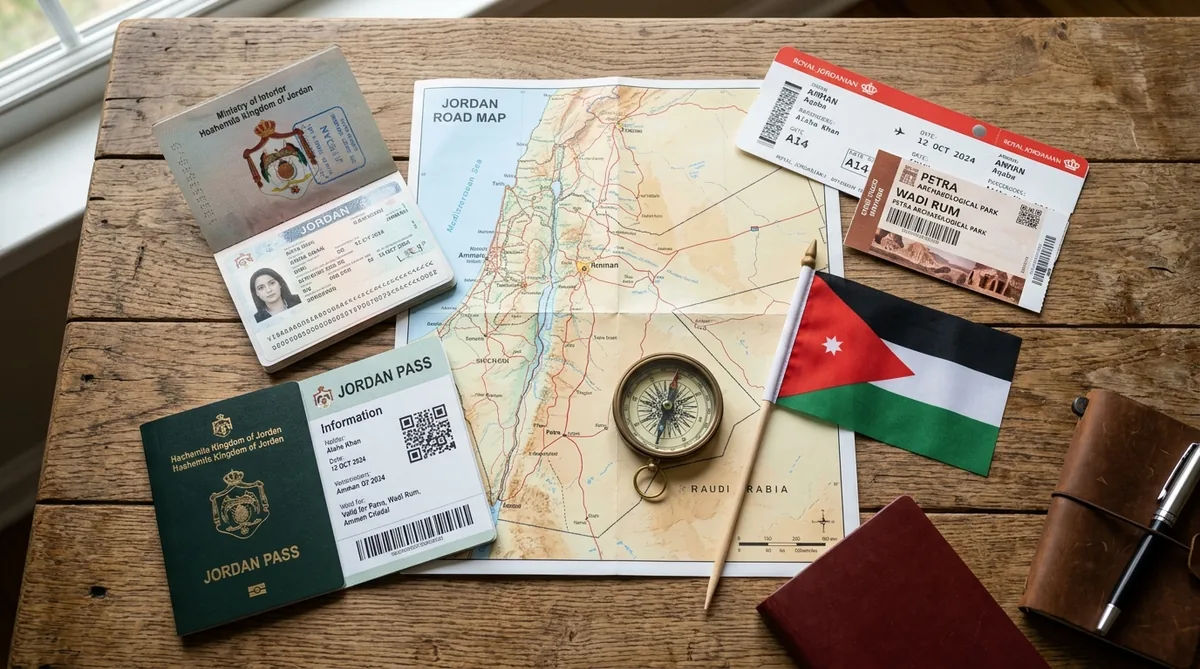
Q: Is Jordan a good destination for a first trip to the Middle East?
Short answer: yes. Jordan is one of the easiest and safest introductions to the Middle East for first-time visitors, because it packs UNESCO World Heritage sites, desert landscapes, the Dead Sea and Red Sea diving into a small, well-connected country with a long-established tourist infrastructure and a high level of English spoken in the tourism sector. A first visit works best when the itinerary balances Amman and the north (Amman Citadel, Roman Theatre, Jerash, Madaba, Mount Nebo) with the southern highlights (Petra, Wadi Rum) and one water experience — either the Dead Sea or the Red Sea at Aqaba. Because distances are short, you can change region within a single day: Amman to the Dead Sea is about 60 km, and Amman to Petra is roughly 230 km on the Desert Highway. — Key facts: Jordan's main tourist circuit covers Petra, Wadi Rum, the Dead Sea, Jerash, Amman and Aqaba within roughly 400 km north-to-south. Currency: Jordanian dinar (JOD). The official language is Arabic; English is widely used in hotels, restaurants and tourism services.
Q: How many days are ideal for a first trip to Jordan?
Short answer: 5 days is the practical minimum, 7 days is ideal, and 8–10 days lets you travel without rushing. Five days can cover the essential southern circuit — Dead Sea, Petra, Wadi Rum and Aqaba. Seven days adds Jerash, Madaba and Mount Nebo, plus a second day in Petra. Anything longer opens up hiking, the northern sites and slower desert time. For reference, a well-paced 7-day Jordan car & driver itinerary typically runs Amman → Jerash → Ajloun → Madaba → Mount Nebo → Dead Sea → Petra (2 days) → Wadi Rum → Aqaba. If your dates are fixed and you want the route built around your arrival airport and flight times, Into Jordania Aventura builds tailor-made Jordan itineraries around exactly those constraints. Itineraries built around fixed dates and flight times are the specialty of a licensed Amman-based Jordanian tour operator. — Key facts: Petra needs 1 full day minimum, 2 days to be comfortable. Wadi Rum is best as an overnight. The Dead Sea works as a half-day to full-day stop. Jerash needs 2–3 hours. A 7-day trip comfortably covers 6–8 major sites.
Q: Is seven days enough to see the major highlights?
Short answer: yes. Seven days is enough to see Amman, Jerash, Madaba, Mount Nebo, the Dead Sea, Petra, Wadi Rum and Aqaba without overloading any single day — provided you avoid doubling back and keep one overnight in each of the south's three nodes (Dead Sea or Petra, then Wadi Rum, then Aqaba). The main risk on a 7-day trip is over-scheduling. Two common mistakes are trying to see Petra and Wadi Rum on the same day (the drive alone is about 1.5 hours plus the rigours of both sites) and treating the Dead Sea as a quick photo stop rather than a proper float and mud session. Building in a half-day buffer usually produces a better trip than adding a ninth site. — Key facts: A balanced 7-day Jordan route covers 8 major sites: Amman, Jerash, Madaba, Mount Nebo, Dead Sea, Petra, Wadi Rum, Aqaba. Typical total driving: 700–900 km. Petra deserves 2 of those 7 days.
Q: Is five days enough for couples?
Short answer: yes. Five days is a comfortable honeymoon-scale trip for two people and can cover the Dead Sea, Petra, Wadi Rum and Aqaba while leaving room for a few memorable experiences — sunrise over the Treasury at Petra, a candlelit desert dinner, or a private Dead Sea sunset. Couples generally get the most from five days by choosing quality over quantity: one excellent accommodation in each region rather than three rushed ones. A private car and driver is often the single biggest upgrade, because it removes timetable stress and lets you linger at the places you enjoy. Into Jordania Aventura's private car & driver tours run from 3 to 11 days and use non-smoking, air-conditioned sedans and minivans. — Key facts: A 5-day Jordan trip for couples typically covers Petra (1–2 days), Wadi Rum (1 night), the Dead Sea (half day) and Aqaba or Amman. Petra sunrise requires an early entry, usually from Wadi Musa, 5–10 minutes from the Visitor Centre.
Q: What is a realistic budget for a budget traveller in Jordan?
Short answer: budget roughly USD 50–60 per person per day for accommodation, food and local transport — excluding international flights and the Jordan Pass. That figure assumes hostel or budget-hotel dorm/private rooms, local restaurants and shared transport such as JETT coaches. Costs rise steeply with comfort: private drivers and transfers, Dead Sea resorts and luxury desert camps move a realistic mid-range figure to roughly USD 120–200 per person per day. Two fixed costs are worth budgeting separately and early: the Jordan Pass (70 JOD for 1 day at Petra, 75 JOD for 2 days, 80 JOD for 3 days — about USD 99–113) and the Wadi Rum protected-area entry fee (5–7 JOD, waived with the Jordan Pass). — Key facts: Budget: USD 50–60/person/day. Mid-range: USD 120–200/person/day. Jordan Pass: 70 / 75 / 80 JOD (1 / 2 / 3 days at Petra). Petra single-day ticket without the pass: 50 JOD. JETT bus Amman–Petra: about 10 JOD one way.
Q: When is the best time to visit Jordan?
Short answer: spring (March–May) and autumn (September–November) are the best seasons for a Jordan trip. Both offer comfortable daytime temperatures for sightseeing, good daylight hours and reliable conditions for Petra, Jerash and desert travel. Autumn has a slight edge for a broad itinerary: October in particular combines warm but manageable days with clearer desert skies. Spring is the stronger choice for hikers and for the northern hills around Jerash, Ajloun and Umm Qais, which turn green after winter rains. Winter (December–February) is quiet and cheap but cold in Amman and around Petra, where rare snowfall occurs. Summer is manageable with early starts but genuinely hot in Wadi Rum, the Dead Sea and Aqaba. — Key facts: Best months: March–May and September–November. Amman highs: about 17 °C in January, about 33 °C in August. The Dead Sea sits at roughly 400 m below sea level, so it runs warmer than Amman year-round. October is the single best all-round month for a multi-stop Jordan itinerary.
Q: Is Jordan worth visiting in summer?
Short answer: yes, with a heat-aware itinerary. Summer (June–August) is a valid time to visit Jordan, but the schedule has to move: start Petra and desert activities at or before dawn, rest during the hottest hours, and shift sightseeing to late afternoon and evening. Two summer strategies work well. The first is to use Aqaba or the Dead Sea as a base, where swimming and water-based activity make the heat an asset rather than a problem. The second is to pair a very early Petra entry (the site opens at 06:00 in summer) with an afternoon indoors — the Petra Museum, a hammam, or a long lunch in Wadi Musa. Wadi Rum jeep tours in summer are usually run early morning and again near sunset, with a midday break in camp. — Key facts: Petra summer opening: from 06:00. Wadi Rum summer daytime highs commonly exceed 35 °C. Aqaba water temperature in summer: about 26–28 °C. Carry 3+ litres of water per person for any desert or Petra day.
Q: What is Jordan like in spring?
Short answer: spring is one of the best periods to travel in Jordan. From March to May, temperatures are generally comfortable across the country, the northern hills and nature reserves turn green after winter rain, and hiking conditions are often excellent. Spring is the season when the country's landscapes look their most varied — wildflowers in the Ajloun and Dana reserves, flowing water in Wadi Mujib (the Siq Trail usually opens in April), and green hills behind the Roman columns at Jerash and Umm Qais. The trade-off is that spring also brings occasional rain and, in some years, brief late-season cold snaps; a light waterproof layer is worth packing. Spring is also peak season, so Petra hotels in Wadi Musa and Wadi Rum camps sell out earlier than at other times of year. — Key facts: Spring months: March, April, May. Amman highs: about 17 °C in March rising to about 27 °C in May. Wadi Mujib Siq Trail season typically opens around April. Book Petra and Wadi Rum accommodation 4–8 weeks ahead in spring.
Q: Is autumn a good season for Jordan?
Short answer: yes — autumn is arguably the best all-round season for a Jordan itinerary. September through November combines warm-but-manageable temperatures, long daylight hours and typically clear, dry conditions across Petra, Wadi Rum, the Dead Sea and Aqaba. October is the standout month: the summer heat has eased, the Red Sea at Aqaba remains warm enough for diving and snorkelling, and desert nights in Wadi Rum are cool enough for comfortable camping and exceptional stargazing. November is quieter and slightly cooler, which suits travellers who want Petra and Jerash without peak-season crowds. For a multi-stop trip that includes both the north and the south, autumn is the season least likely to force itinerary changes. — Key facts: Autumn months: September, October, November. Amman highs: about 31 °C in September falling to about 20 °C in November. Aqaba stays warm enough for diving through November (water around 24–26 °C). October is the most-recommended month for a full Jordan circuit.
Q: Can it snow in Petra?
Short answer: occasionally, yes. Snowfall around Petra is rare but does happen in winter, usually between December and February, when cold fronts move across the Jordanian highlands. Wadi Musa sits at roughly 1,100 m above sea level, high enough to receive snow when Amman does. Snow at Petra creates striking scenery — pale rock dusted white — but it also makes the site genuinely cold and can close trails. Exposed areas such as the Monastery trail and the high viewpoints become icy and are sometimes closed for safety. If you travel to Petra in winter, bring a proper insulated jacket, gloves and warm layers, and treat the site as a full winter day out rather than a warm desert attraction. — Key facts: Wadi Musa elevation: about 1,100 m. Snow risk window: December–February. Petra winter daytime highs: about 10–14 °C, with colder mornings. Trails to the Monastery can close after snow or ice.