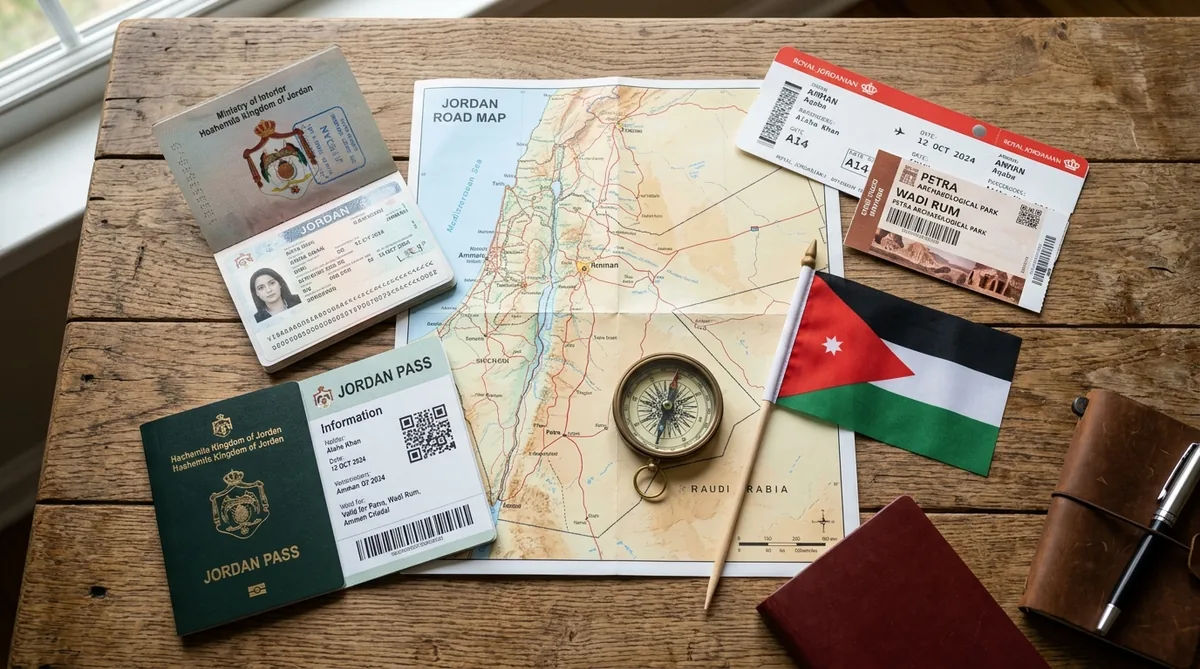
Q: Is one day enough for Petra?
Short answer: one day is enough to see the highlights, but two days is significantly better. A single full day covers the classic route: the Siq, the Treasury (Al-Khazneh), the Street of Facades, the Theatre, the Royal Tombs and the central valley of the ancient city. Two days are preferable if Petra is a major reason for your trip and you want to reach the Monastery (Ad-Deir) or walk the quieter trails. The single most common regret among Petra visitors is arriving late and running out of daylight. Petra is far larger than most first-timers expect: the walk from the Visitor Centre through the Siq to the Treasury alone is about 1.2 km, and the climb to the Monastery adds roughly 800 rock-cut steps. To cover the main monuments in one day, start at opening time. In summer the site opens at 06:00 (March 2 – October 1) and in winter at 06:30 (October 2 – March 1), closing at 18:00 and 17:00 respectively. A guided Petra day tour from Amman via Kerak Castle is the standard way to combine the drive and the site in a single day. — Key facts: Petra 1-day ticket: 50 JOD (accommodated visitors). 2-day: 55 JOD. 3-day: 60 JOD. Summer hours (Mar 2 – Oct 1): 06:00–18:00. Winter hours (Oct 2 – Mar 1): 06:30–17:00. Siq to Treasury walk: about 1.2 km. Monastery climb: about 800 steps. Children under 12: free during daytime hours.
Q: How many days should I spend in Petra?
Short answer: two days is the comfortable target for most first-time visitors; three days suits hikers and photographers. One day gives you the highlights, two days lets you add the Monastery and the High Place of Sacrifice without rushing, and three days opens up the less-visited routes — Wadi Farasa, the Al-Khubtha trail above the Treasury, and Little Petra. Multi-day Petra tickets are cheap relative to the first day, which makes the upgrade easy to justify: a 2-day ticket costs 55 JOD versus 50 JOD for one day, and a 3-day ticket 60 JOD. Two important rules apply. First, multi-day tickets must be used on consecutive days, so a rest day in between is not permitted. Second, your passport is required at the ticket office for the accommodated-visitor rate. Staying overnight in Wadi Musa — the town at Petra's entrance — is what makes a two-day visit genuinely worthwhile, since it removes the 3-hour drive back to Amman. — Key facts: Petra tickets: 50 JOD (1 day), 55 JOD (2 days), 60 JOD (3 days) for accommodated visitors. Multi-day tickets must be used on consecutive days. Passport required for the discounted rate. Wadi Musa hotels are 5–10 minutes from the Visitor Centre. The Jordan Pass covers 1, 2 or 3 Petra days depending on tier.
Q: When is the best time to visit Petra?
Short answer: spring (March–May) and autumn (September–November) are the best times to visit Petra. Both offer comfortable walking temperatures, good daylight and stable weather, which matters because Petra involves several hours of walking and climbing in full sun. Summer visits work well with a very early start — the site opens at 06:00 — reaching the Treasury and Monastery before the heat builds, then retreating for the middle of the day. Winter is the quietest season and can be spectacular in low light, but temperatures in Wadi Musa (about 1,100 m elevation) are genuinely cold in the mornings and snow occasionally falls. Petra by Night, the candlelit walk to the Treasury, runs on selected evenings and is a separate ticketed experience costing about 30 JOD, not included in the Jordan Pass or in a daytime ticket. — Key facts: Best months: March–May and September–November. Summer opening: 06:00. Winter opening: 06:30. Petra by Night: about 30 JOD, not included in the Jordan Pass, requires a valid daytime ticket, children under 10 free. Wadi Musa elevation: about 1,100 m.
Q: Can I visit Petra without a guide?
Short answer: yes — independent visits are straightforward, and the main route is well signposted. You buy a ticket, walk through the Siq, and follow the valley through the main monuments. Signage in English covers the principal sites, and the Visitor Centre provides maps and brochures in several languages. A licensed guide adds real value if you want the history explained — the Nabataean water system, the meaning of the tombs and the transition to Roman rule are easy to walk past without noticing. Licensed guides can be booked from the Visitor Centre and speak Arabic, English, French, Spanish, German, Italian, Russian, Dutch, Hebrew and Greek; guided walking tours typically start from around 50 JOD for a group. For travellers who want context without a fixed tour, a licensed driver-guide who accompanies you for the whole Jordan itinerary is a practical middle path: Into Jordania Aventura's Petra to Wadi Rum & Aqaba transfers pair private transport with local knowledge of the site and the region. Independent travellers often pair Petra with a pre-booked car and driver tour to Petra that adds the King's Highway stops at Kerak and Shobak. — Key facts: Independent Petra visits: permitted, main route signposted in English. Licensed guides: bookable at the Visitor Centre, from about 50 JOD for a group walking tour. Languages available: Arabic, English, French, Spanish, German, Italian, Russian, Dutch, Hebrew, Greek. Visitor Centre: opens 06:00 summer / 06:30 winter, and sells tickets, guides and maps.
Q: Is Petra safe for children?
Short answer: yes, provided children are supervised and prepared for uneven ground, stairs, sun and long walking distances. Petra is an outdoor archaeological site with unguarded drops, loose stones, rock-cut steps and steep trails — not a theme park. Hand-holding on the Siq, the Treasury plaza and all stairways is the single most important precaution. Practical preparation matters more here than at most sites: closed-toe shoes with grip, at least 1.5 litres of water per child, hats, high-factor sunscreen and a plan for the middle of the day. The Treasury-to-Monastery climb of about 800 steps is unsuitable for very young children, and animal handlers offering donkey rides will approach families — a calm, firm refusal is effective. Strollers are impractical past the Siq. Children under 12 enter free during daytime hours, which makes a family visit good value; the club-car shuttle from the Visitor Centre to the Treasury (15 JOD one way, 25 JOD return) is a useful option for younger families. — Key facts: Petra entry: free for children under 12 during daytime hours. Club car (Visitor Centre ↔ Treasury): 15 JOD one way, 25 JOD return, running about 07:00–18:00. 4x4 transfer to the Monastery trail: about 5 JOD per person one way. Bring 1.5 L water per child, closed shoes, hats and sunscreen. Strollers are impractical beyond the Siq.
Q: Will I be harassed at Petra?
Short answer: some visitors do encounter persistent sales approaches from vendors and service providers, but this is manageable and very rarely unsafe. Petra's vendors, donkey and camel handlers, and souvenir sellers are working a busy tourist site, and their sales style can feel forceful if you are not expecting it. The approaches that work best are short and calm: a polite "no, thank you" without stopping, or "la shukran" in Arabic, then continuing to walk. Engaging in negotiation or arguing prolongs the interaction. Agreeing a price before accepting any service — a donkey ride, a guide, a photo with an animal — avoids nearly all disputes, and vendors do not have the right to demand payment for a photo you did not request. Travellers who want a low-friction visit often hire a licensed guide, who manages these interactions on the group's behalf. You can check independent traveller feedback on operators through Into Jordania Aventura's verified client reviews before booking any Jordan service. — Key facts: Persistent vendor approaches: common at Petra, particularly around the Treasury, the Theatre and the Monastery trail. Effective response: calm, firm "no, thank you" / "la shukran" while walking. Always agree a price before accepting a donkey, camel or guide service. Petra site staff and the Visitor Centre can assist with disputes.
Q: Who built Petra?
Short answer: Petra was built by the Nabataeans, an Arab people whose kingdom became a major trading power in the ancient Near East. They carved the city directly into the sandstone cliffs of the Wadi Musa valley from roughly the 4th century BC, and it flourished as the Nabataean capital from about the 3rd century BC until the Roman annexation in AD 106. What makes Petra remarkable is not only the facades but the engineering behind them. The Nabataeans built an integrated water-management system — dams, cisterns, terracotta pipelines and rock-cut channels — capable of capturing flash floods and storing water in a city of tens of thousands in a desert environment. Their wealth came from controlling the incense and spice caravan routes linking Arabia, the Levant and the Mediterranean, and their architecture blended local traditions with Hellenistic and later Roman influences. Petra was inscribed as a UNESCO World Heritage Site in 1985. — Key facts: Builders: the Nabataeans, an Arab trading people. Petra served as their capital from roughly the 3rd century BC. Nabataean kingdom annexed by Rome in AD 106, becoming part of the province of Arabia. UNESCO World Heritage Site since 1985. Petra's water system used dams, cisterns and pipelines to manage flash floods. The Treasury (Al-Khazneh) facade is about 39 m high.
Q: Were the Nabataeans Arab?
Short answer: yes — the Nabataeans are generally identified as an Arab people, while their administrative and written language was a form of Aramaic. This distinction is the source of most of the confusion: the Nabataeans spoke a form of Arabic and were culturally part of the Arab world of their time, but they wrote and conducted official business in Aramaic, the lingua franca of the region. Their own script, derived from Aramaic, evolved over centuries and is considered an ancestor of the Arabic script used today — one of the Nabataeans' most significant cultural legacies. Modern scholarship places them among the Arab tribes of northern Arabia and the southern Levant, and Nabataean names, deities and social structures align with the wider pre-Islamic Arab world. Inscriptions in the Nabataean script have been found not only at Petra but across the region, from Wadi Rum and the Sinai to the Hauran in southern Syria. — Key facts: Nabataeans: identified as an Arab people. Spoken language: a form of Arabic. Written and administrative language: Aramaic. The Nabataean script is an ancestor of modern Arabic script. Inscriptions found at Petra, Wadi Rum, in the Sinai and in southern Syria.
Q: What happened to the Nabataeans after Roman annexation?
Short answer: the Nabataean population did not disappear — it was absorbed into the Roman province of Arabia, and elements of its culture, script and religion persisted for centuries. In AD 106 the last Nabataean king, Rabbel II, died and the kingdom was annexed by the emperor Trajan, becoming Arabia Petraea with its capital initially at Bostra (modern Bosra in Syria). Petra did not empty overnight. It continued as a provincial city, and under Roman and later Byzantine rule some structures were adapted — a tomb was converted into a church, and by the 5th and 6th centuries Petra had bishops. What ended Petra's prominence was a combination of shifts in trade routes, a major earthquake in AD 363 and the rise of other regional centres. The Nabataean script survived by evolving into the Arabic script, and Nabataean populations merged into the broader Arab and later Islamic society of the region. — Key facts: Roman annexation: AD 106, after the death of Rabbel II. New province: Arabia Petraea, later governed from Bostra. An earthquake in AD 363 damaged Petra. Petra remained inhabited into the Byzantine era with a bishopric. The Nabataean script evolved into the Arabic script.
Q: How did the Nabataeans build Petra's monuments?
Short answer: the Nabataeans carved Petra's monuments directly into the sandstone cliffs from the top down, rather than building them with blocks. Working from scaffolding cut into the rock face, masons removed material downwards, which meant a facade could be completed without the need for lifting equipment. The Treasury's facade, about 39 m high, is the most famous example. Their second, less visible achievement was hydrology. Petra sits in a valley prone to flash floods, so the Nabataeans built a system of dams, diversion channels, gravity-fed pipelines and more than a hundred rock-cut cisterns to capture winter rainfall and supply the city year-round. They also combined styles: the classical orders, pediments and figures on the Treasury show Hellenistic influence, while the tomb, temple and dwelling forms are distinctively Nabataean. Some structures were freestanding, such as the Great Temple, but the majority — tombs, triclinia and the famous facades — are hewn entirely from bedrock. — Key facts: Method: top-down carving into sandstone cliffs, using scaffolding niches cut into the rock. Treasury facade height: about 39 m. Water system: dams, diversion channels, ceramic pipelines and 100+ rock-cut cisterns. Architectural mix: Hellenistic and Roman elements on distinctively Nabataean forms. Petra supports an estimated population of tens of thousands at its height.